Why rewild schools?
Concrete traps heat. Nature restores balance.
Rewilding brings shade, vegetation, and permeable ground back into the school environment—improving comfort during heatwaves and resilience during heavy rain.
GREEN-SY is an eTwinning project where students redesign outdoor school spaces to reduce heat, improve drainage, restore biodiversity, and strengthen wellbeing—while collaborating in English with partner schools across Europe.

GREEN-SY rewilds schoolyards using nature-based solutions—cooler spaces, better drainage, more biodiversity, and stronger student agency.
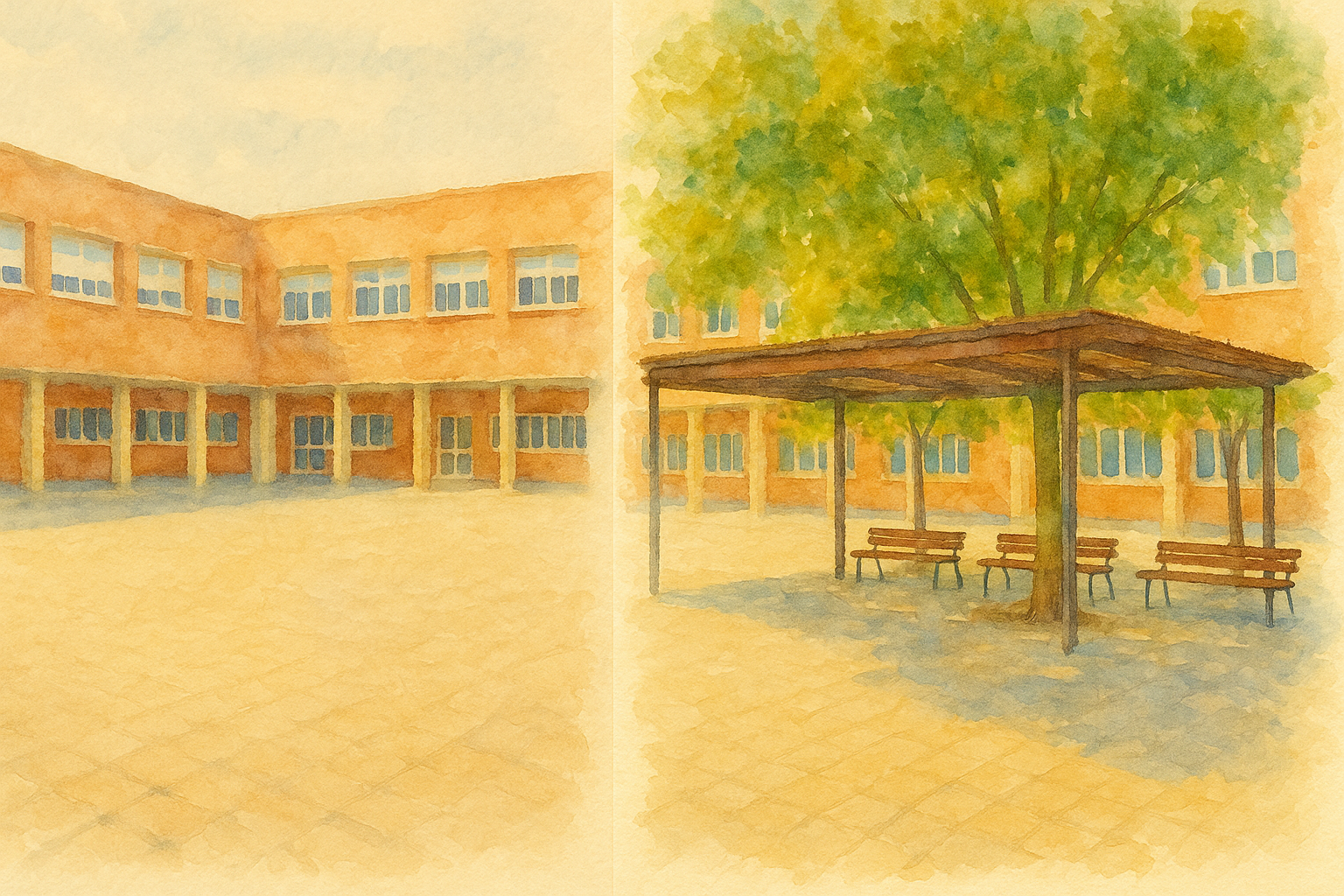
Rewilding brings shade, vegetation, and permeable ground back into the school environment—improving comfort during heatwaves and resilience during heavy rain.
A structured, season-smart approach designed for meaningful student learning, visible outdoor change, and evidence that can be shared with partners and the wider community.

Methodology: Project-Based Learning + action research + service learning + international collaboration.
Secondary students collaborate across borders using English as the working language, supported by teachers and local partners.
Typically: one coordinating school in Spain + 2–4 partner schools in Europe. Interdisciplinary participation across Science, Geography, Arts, Technology, PE, and Languages.
Multiple contribution pathways (manual, creative, technical, organisational). SEN-friendly adjustments, accessible routes, step-by-step supports, and privacy-first digital collaboration.

The rest of the website now lives in dedicated subpages with themed banners, richer visual storytelling, and galleries for partners and news.

Evidence-based environmental, educational and social outcomes.

A proper gallery of updates with image-led storytelling.

A partnership gallery designed to showcase collaborators with confidence.